
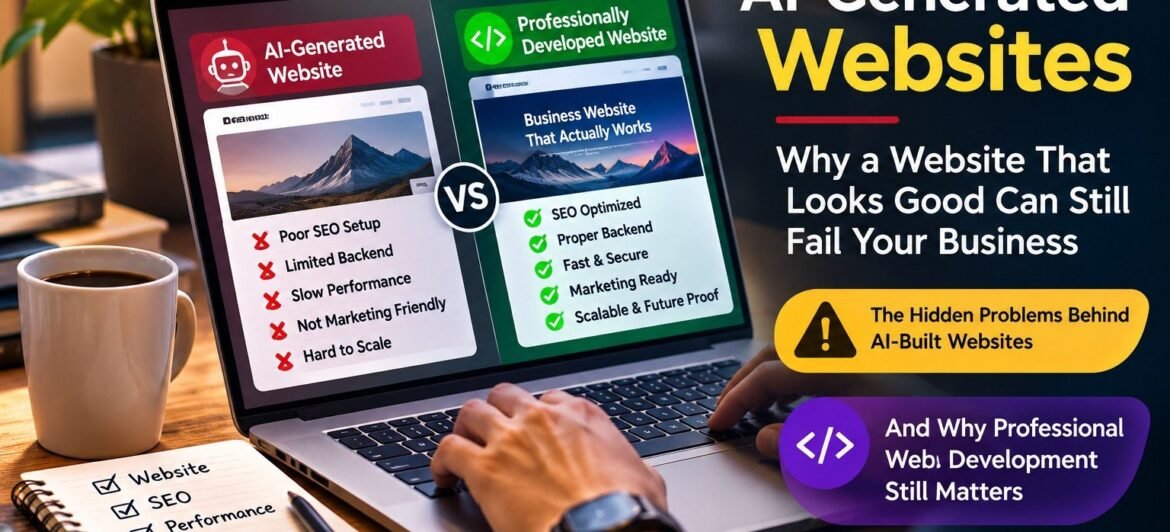
An attractive website is not necessarily a successful website. Discover the hidden SEO, performance, security, backend, and marketing problems behind poorly developed AI-generated websites — and why professional development still matters.
Introduction
Artificial intelligence has changed the way websites are created. Today, almost anyone can generate a website within minutes using AI-powered website builders, automated coding tools, and ready-made templates.
For business owners, this sounds like an excellent opportunity. Instead of investing in professional website development, they can purchase an inexpensive website from an individual or agency offering AI-generated solutions.
Initially, everything looks promising. The website has attractive layouts, modern typography, impressive images, and professionally written content. It may even look similar to websites developed by experienced professionals.
However, there is a significant difference between a website that looks good and a website that actually works for a business.
Many websites created through poorly managed AI development workflows lack proper technical architecture, search engine optimisation, marketing integration, backend functionality, and long-term scalability.
The result? Businesses invest in websites that look impressive but struggle to generate organic traffic, attract enquiries, convert visitors, or support business operations.
AI is not the problem. The problem is treating AI-generated output as a finished professional website without proper development, testing, optimisation, and technical implementation.
1. AI-Generated Websites Often Look Better Than They Actually Perform
One of the biggest attractions of AI website generators is their ability to create visually appealing layouts quickly.
They can generate landing pages, service sections, contact forms, product displays, and even complete website structures.
But visual appearance is only one part of website development.
A professional business website must also consider:
Website architecture and clean code structure.
Mobile responsiveness across different devices.
Page loading speed and Core Web Vitals.
Search engine accessibility and crawlability.
Proper navigation and internal linking.
Functional contact forms and enquiry management.
Security and backend configuration.
Conversion-focused user experience.
An AI-generated website may successfully display all the expected sections without implementing the technical requirements behind them.
A website should not simply impress visitors. It should help businesses achieve measurable objectives.
2. Poor SEO Structure Makes It Difficult to Rank on Google
One of the most common problems with poorly developed AI websites is inadequate search engine optimisation.
Business owners often assume that having website content, headings, images, and service descriptions automatically makes their website SEO-friendly.
Unfortunately, it does not.
Search engines need to understand the structure, relevance, accessibility, and purpose of individual pages.
Common SEO problems include:
Incorrect heading hierarchy and multiple unnecessary H1 tags.
Missing or duplicated SEO titles and meta descriptions.
Poor URL structures.
Missing canonical tags.
Incorrect robots.txt configuration.
Missing or improperly configured XML sitemaps.
Lack of structured data and relevant schema markup.
Broken internal links and poor content organisation.
Missing image alt attributes.
Thin, duplicated, or generic AI-generated content.
A website can look perfectly fine to visitors while having serious technical SEO problems behind the scenes.
For example, a company offering web development services in London may have an attractive homepage, but without properly structured service pages, relevant content, local search optimisation, and technically accessible pages, it may struggle to appear for relevant searches.
A website needs an SEO strategy built into its development process, not SEO added as an afterthought.
3. AI-Generated Content Does Not Automatically Bring Google Rankings
AI can generate articles, service descriptions, product information, and landing page content within seconds.
However, publishing large amounts of generic AI-generated content is not a reliable SEO strategy.
Search engines aim to provide useful, relevant, and trustworthy information to users.
Content that simply repeats common information without providing original insights, practical experience, or meaningful value may struggle to compete.
Common content problems include:
Repetitive paragraphs across multiple pages.
Generic service descriptions.
No clear understanding of the target audience.
Incorrect or unsupported information.
Missing industry-specific knowledge.
No practical examples or real project experience.
Poor keyword targeting and search intent alignment.
AI should assist with research, organisation, and content development. It should not replace industry knowledge, professional judgement, or genuine experience.
Businesses need content that answers customer questions, demonstrates expertise, and gives potential customers a reason to choose them.
4. Missing or Poorly Developed Backend Functionality
A website is not just a collection of frontend sections.
Behind every professional business website, there should be a properly configured backend that manages its content, users, enquiries, products, integrations, and other business operations.
This is where many rushed website projects become problematic.
Some websites are delivered with attractive frontend designs but incomplete or poorly configured backend functionality.
Examples include:
Contact forms that do not deliver enquiries.
Missing email notification configurations.
Incorrect SMTP settings.
Poorly configured database structures.
Inadequate user permissions.
Missing form validation and spam protection.
Incomplete eCommerce functionality.
Unreliable third-party integrations.
No proper backup or recovery strategy.
For an online business, these are not minor technical issues.
Imagine a company spending money on advertising to generate enquiries, only to discover that its contact form is not sending emails.
The website may be receiving visitors, but the business is losing potential customers because its backend is not functioning correctly.
A professional website must work reliably behind the scenes, not just look impressive on the screen.
5. Websites Without Marketing Integration Cannot Support Business Growth
A business website should be part of its overall marketing and customer acquisition strategy.
Simply publishing a website does not guarantee visitors, leads, or sales.
Unfortunately, many basic AI-generated websites are delivered without considering how the business will attract and convert potential customers.
Important marketing requirements may be missing:
Google Analytics 4 integration.
Google Search Console configuration.
Google Tag Manager implementation.
Conversion and enquiry tracking.
Meta Pixel integration where required.
Proper call-to-action placement.
Landing pages for advertising campaigns.
Lead capture and email marketing integrations.
Search engine optimisation and content strategy.
Without these elements, businesses may struggle to understand where their visitors come from, which pages generate enquiries, and which marketing activities produce results.
A properly developed website should provide a foundation for SEO, paid advertising, analytics, lead generation, and future marketing activities.
6. Poor Website Performance and Mobile Experience
Website speed and usability directly influence the experience visitors have when interacting with a business.
Some quickly generated websites contain unnecessary scripts, oversized images, inefficient code, excessive animations, and poorly implemented third-party resources.
These issues can contribute to:
Slow page loading.
Poor mobile performance.
Layout shifts while pages load.
Unresponsive navigation.
Delayed interaction.
Poor Core Web Vitals performance.
A website that looks excellent on a desktop may provide a completely different experience on a mobile device.
Professional development involves testing and optimising the website across different screen sizes, browsers, and devices.
Performance should be considered throughout development rather than treated as a final adjustment.
7. Security and Scalability Are Often Overlooked
A business website is a long-term digital asset. It needs to remain secure, manageable, and adaptable as the business grows.
However, websites developed without proper technical planning can create problems when businesses need to expand their functionality.
Potential issues include:
Outdated plugins and dependencies.
Insecure configurations.
Weak user access controls.
Missing backups.
Poorly maintained integrations.
Inadequate form security.
Difficulties updating website content.
Limited support for future functionality.
For example, a business may initially need only a corporate website. Later, it may require an online store, customer portal, booking system, CRM integration, or custom application.
If the original website was not developed with a suitable architecture, adding these features can become unnecessarily expensive and complicated.
Professional website development should consider not only what a business needs today but also how its digital platform may evolve.
8. The Real Problem Is Not AI — It Is the Lack of Professional Development
AI is an incredibly useful tool in modern web development.
Experienced developers can use AI to accelerate coding, assist with debugging, explore solutions, improve workflows, and reduce development time.
However, AI-generated code and designs still require professional evaluation.
Someone needs to understand whether the generated solution is technically correct, secure, maintainable, accessible, and suitable for the business.
The right development approach combines:
AI-assisted development.
Professional frontend and backend implementation.
Proper technical architecture.
Search engine optimisation.
Performance optimisation.
Security best practices.
Marketing and analytics integration.
Quality assurance and ongoing maintenance.
AI can accelerate development, but professional expertise determines whether the final website is suitable for real business requirements.
9. What Businesses Should Look for When Hiring a Web Developer or Agency
Before investing in a website, businesses should look beyond attractive designs and low development costs.
Ask potential developers or agencies the following questions:
Is the website being developed with proper SEO structure?
Will the website be optimised for mobile devices and performance?
Are contact forms, email notifications, and backend functionality tested?
Will Google Analytics and Search Console be configured?
Is the website built on a platform that supports future growth?
Are security, backups, and maintenance considered?
Will the website be tested before launch?
Can the development team provide ongoing technical support?
A reliable development partner should understand both the technical requirements and the business objectives behind a website.
The objective should not simply be to deliver a website. It should be to build a digital platform that supports business growth.
Why Work With an Experienced Web Developer?
With over five years of experience in web development, I understand that successful websites require much more than attractive layouts and automated code generation.
My work focuses on building and managing business websites with the technical foundations required for performance, usability, security, and long-term growth.
I work across a range of web development technologies and platforms, including:
WordPress Development: Custom business websites, Elementor, theme customisation, performance optimisation, and technical SEO.
Shopify Development: Custom Shopify stores, theme development, eCommerce functionality, and integrations.
WooCommerce Development: Online stores, product management, payment integrations, and custom functionality.
Python & Django Development: Backend development, database-driven applications, and custom software solutions.
Website Performance & Security: Speed optimisation, technical troubleshooting, website security, and maintenance.
Technical SEO Implementation: Website architecture, schema markup, crawlability, indexing, and on-page optimisation.
I have worked with businesses and projects across India, the United Kingdom, and the GCC, delivering solutions for different industries and business requirements.
Whether you are a startup looking to establish your online presence, an established company planning a website revamp, or an agency seeking an experienced development partner, I can help turn your requirements into a reliable digital solution.
Need a Website That Does More Than Look Good?
If you are planning a new website, struggling with an existing website, or looking for an experienced web developer to join your company or support your projects remotely, let’s discuss your requirements.
I am open to full-time web development opportunities, remote positions, freelance projects, contract work, and technical development partnerships.
Let’s build a website that works for your business.
Get in touch:
Email: info@vishnuvenugopal.dev
WhatsApp: +91 7736 4801 00
Website: https://vishnuvenugopal.dev/
Portfolio: https://vishnuvenugopal.dev/portfolios/
🔗 Final Thoughts
A custom-built website gives businesses a competitive edge, ensuring better SEO rankings, increased traffic, and stronger brand authority.